How Much Should You Spend on Facebook Ads In Sydney In 2026?

How much should you spend on Facebook ads in Sydney in 2026? It’s a question that keeps Founders up at night – especially those who rely on paid acquisition to grow their business. At Karma Media, we keep seeing the same pattern play out over and over: great products, a funnel that works okay, but ad spend is always chosen based on gut feeling rather than the cold, hard numbers of unit economics.
And yes, if you’ve ever hired one of those traditional Facebook marketing agency in Sydney and got a load of unclear benchmarks and inconsistent results, you know the pain this can cause.
This article is going to give you a clear, no-nonsense approach to figuring out how much to spend on Facebook ads in Meta’s 2026 auction environment – actually spending in a way that will benefit your ad bidding.
Contents
- 1 The Key Financial Pressures Shaping Paid Social This Year
- 2 The Commercial Logic Behind Budget Setting
- 3 A Practical View of Budget Expectations
- 4 How to Structure Spend for Predictable Outcomes
- 5 Scaling Without Breaking the System
- 6 Examples of Sustainable Budget Logic
- 7 Strategic Close
- 8 FAQ
- 8.1 What’s the minimum I should spend on Facebook ads in Sydney?
- 8.2 How long before my ads actually start working and the numbers stabilise?
- 8.3 Should I just keep pushing the ads if the CAC (cost per acquisition) is still unstable?
- 8.4 What sort of percentage of my revenue should I be devoting to ad spend?
- 8.5 Are Facebook ads still worth it for Australian businesses?
The Key Financial Pressures Shaping Paid Social This Year
In the Sydney market, and actually in most metro markets now, the auction pressure is tighter than ever due to rising ad costs and an awful lot more competition for attention. When your CPMs start to rise, it just amplifies weaknesses in your ad creative, landing pages, and conversion rate. According to Meta ANZ and IAB Australia, demand still outstrips supply, especially when you’re targeting businesses that reach broad consumer groups.
The reason this matters is that your media efficiency is no longer about making a few nifty tweaks – it’s about having a solid budget, clear conversion events, and ad creative that actually works. Ninety per cent of the time, poor performance isn’t down to “the algorithm” – it’s because your budget, your ad signal, and your business goals just don’t align properly.
The Commercial Logic Behind Budget Setting
Most underperforming accounts fail well before the first impression is served — at the budgeting stage. To determine appropriate ad spending, founders need a clear decision sequence rooted in their own economics.
Defining Acceptable CAC
Your CAC needs to be in line with your contribution margins and revenue targets – not some arbitrary number that you plucked out of thin air. If you don’t take into account all the extra costs that go into fulfilling your orders – shipping, support, overheads, the list goes on – your CAC will be way too optimistic, and your funnel will burn out quickly.
Understanding LTV
Your LTV will tell you how aggressively you can bid in the auction. The stronger your retention metrics, the more flexibility you have to absorb higher acquisition costs – especially if you’re in e-commerce.
Mapping Contribution Margin
And here’s the thing – ROAS (return on ad spend) isn’t the only thing that matters. A strong margin profile is what lets you scale your business without losing your shirt when your ad spend goes up.
Matching Spend to Algorithm Requirements
Right now, Meta’s delivery system is all about volume-based optimisation – which means:
- Daily budgets need to be stable
- Conversion events need to be clean
- Ad creative quality needs to be top-notch
Small budgets screw up the optimisation and stop the system from working properly, so it’s pretty much essential to get this right.
A Practical View of Budget Expectations
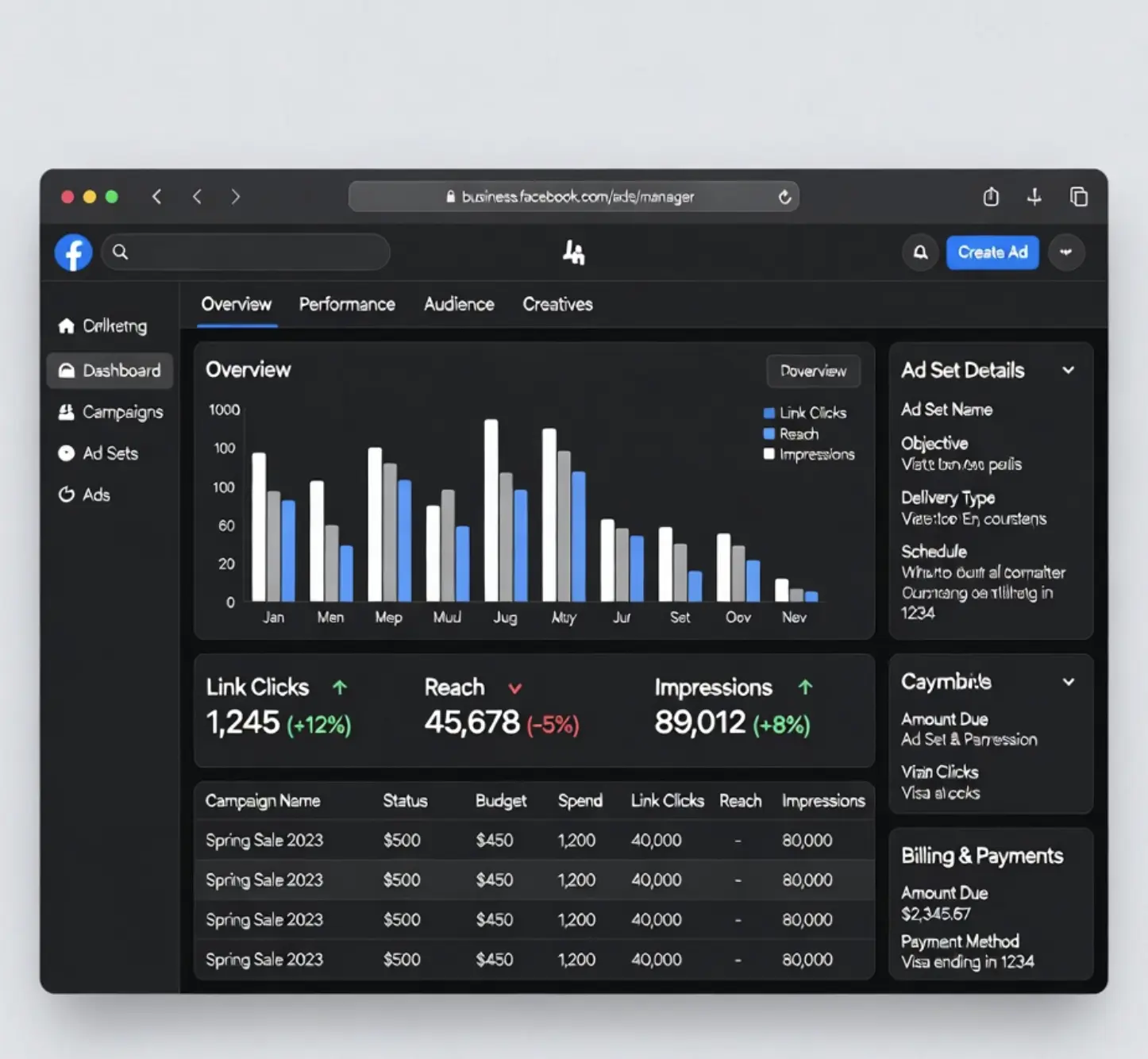
The table below summarises realistic investment levels for different types of Australian businesses operating under competitive metro auction conditions. This is based on Karma Media’s account audits and industry-wide performance benchmarks.
Recommended Monthly Ad Spend Framework
| Business Type | Typical Monthly Revenue | Recommended Ad Spend | Strategic Notes |
|---|---|---|---|
| Local Services | $30k–$150k | $3k–$15k | Works best with strong landing pages and clean qualification steps. |
| E-Commerce Brands | $50k–$400k | $8k–$40k | Requires frequent creative updates to avoid ad fatigue. |
| High-Ticket Service | $80k–$500k | $10k–$50k | Funnel quality heavily influences outcomes. |
| National Retail or Service | $300k–$2M | $40k–$250k | Benefits from broad targeting and full-funnel structure. |
These ranges reflect what is required for the algorithm to reach predictable learning and stabilise ad performance.
How to Structure Spend for Predictable Outcomes
A budget that’s not backed by a robust way to divide up your spend just isn’t going to cut it. Even if you’ve got a good level of spend, you’re not going to get the results you want without a solid framework to guide your allocations.

Allocating Spend Across the Funnel
A healthy model will usually have a certain split of spend across a few key areas. Typically, that’s:
- A decent chunk to focus on building up the top of the funnel and generating new interest through pretty broadly targeted ads.
- A bit more to make sure you’re broadcasting a consistent message and sending the right signals to potential customers.
- A smaller but still important amount to capture the interest of people who’ve already shown some engagement.
- And finally, a bit to make sure you’re taking care of the customers you already have and keeping them loyal, which also helps keep your costs down in the long run.
This way, you’re making sure that new and returning customers are getting a consistent view of your brand – and that your system has enough data to learn and adapt.
Supporting Creative Volume
These days, the way your ads are performing has a lot more to do with the quality of your ad creative than ever before. If that gets stale, you’ll start to see your costs go up, and your engagement go down. And before you know it, you’ll be stuck on a delivery deal that’s not doing much for you anymore. Brands need to be churning out new ideas, new formats and new concepts all the time to keep their system engaged – and keep beating the competition.
Scaling Without Breaking the System
Scaling up requires discipline. Too many startups throw more money at the problem without thinking through the implications – and end up destabilising the whole thing.
Stability Before Scale
Only scale up when things are stable – and that means not just when the money is going in, but when conversion rates and ad relevance are all still pointing in the right direction. If you start scaling up and see those numbers go down, then you’re just making things worse.
Incremental Adjustments
There’s a sweet spot with algorithmic systems – and that’s where you make small, controlled increases. A big change is just going to throw everything off – and make it harder to figure out what’s going on. Take it one step at a time, and you’ll be a lot less likely to cause any disruption.
Maintaining Margin Integrity
When you are scaling up, don’t lose sight of what’s really important: keeping a healthy profit margin. Rising ad costs, or losing customers because you’ve got nothing new to offer – these are all just going to eat away at what you’re making, and make it harder to stay on top.
Examples of Sustainable Budget Logic
For a business bringing in about $150k per month, with a CAC of $80 and an LTV of $300, you’ll typically need to be spending around $12k to $18k on ads just to stay on stable ground. That gives Meta enough data to work with and the right volume of funnel activity to give you a consistent flow of good-quality leads.
Going below that threshold is just going to end up with a whole lot more volatility – and some pretty underwhelming ad performance. And it’s not because your product is weak – it’s just that there’s not enough data to work with. So you’re not going to get the results you want.

Strategic Close
Budgeting for paid social isn’t just a case of “let’s start small and see how it goes“. It’s a genuine business strategy. If you underfund it, advertising is going to be all over the place, but on the other hand, if you pour too much in without getting the creative and sales funnel right, you’re just throwing money away. However, with the right framework in place, solid creative pipelines and a budget that actually reflects the auction requirements, any business can build a reliable growth engine that delivers.
At Karma Media, we work with brands that approach acquisition as a business system – not a wild guess. If you want to get a no-nonsense, commercially sound assessment of your ad spend and the budget you need to reach your targets, we can work through the numbers – all based on revenue logic.
FAQ
What’s the minimum I should spend on Facebook ads in Sydney?
Around $3k–$5k/month to exit learning and generate stable signal quality.
How long before my ads actually start working and the numbers stabilise?
To be honest, you’re probably looking at 4 to 6 weeks before things start to settle down. Facebook’s optimisation algorithms aren’t exactly built for speed; they care more about how much decent data they can get their hands on.
Should I just keep pushing the ads if the CAC (cost per acquisition) is still unstable?
Absolutely not. If your CAC is all over the place, your priority should be to get the creative, the landing page, the attribution, and the targeting sorted out first.
What sort of percentage of my revenue should I be devoting to ad spend?
For most Sydney businesses and most categories, it tends to be around 8-15% of your revenue. Of course, the exact number depends on your margin and industry.
Are Facebook ads still worth it for Australian businesses?
You bet they are – provided you’re actually investing enough to get some proper data out of the system and you’ve also got a solid marketing strategy in place with quality creative and a sales funnel that’s ready to go.